
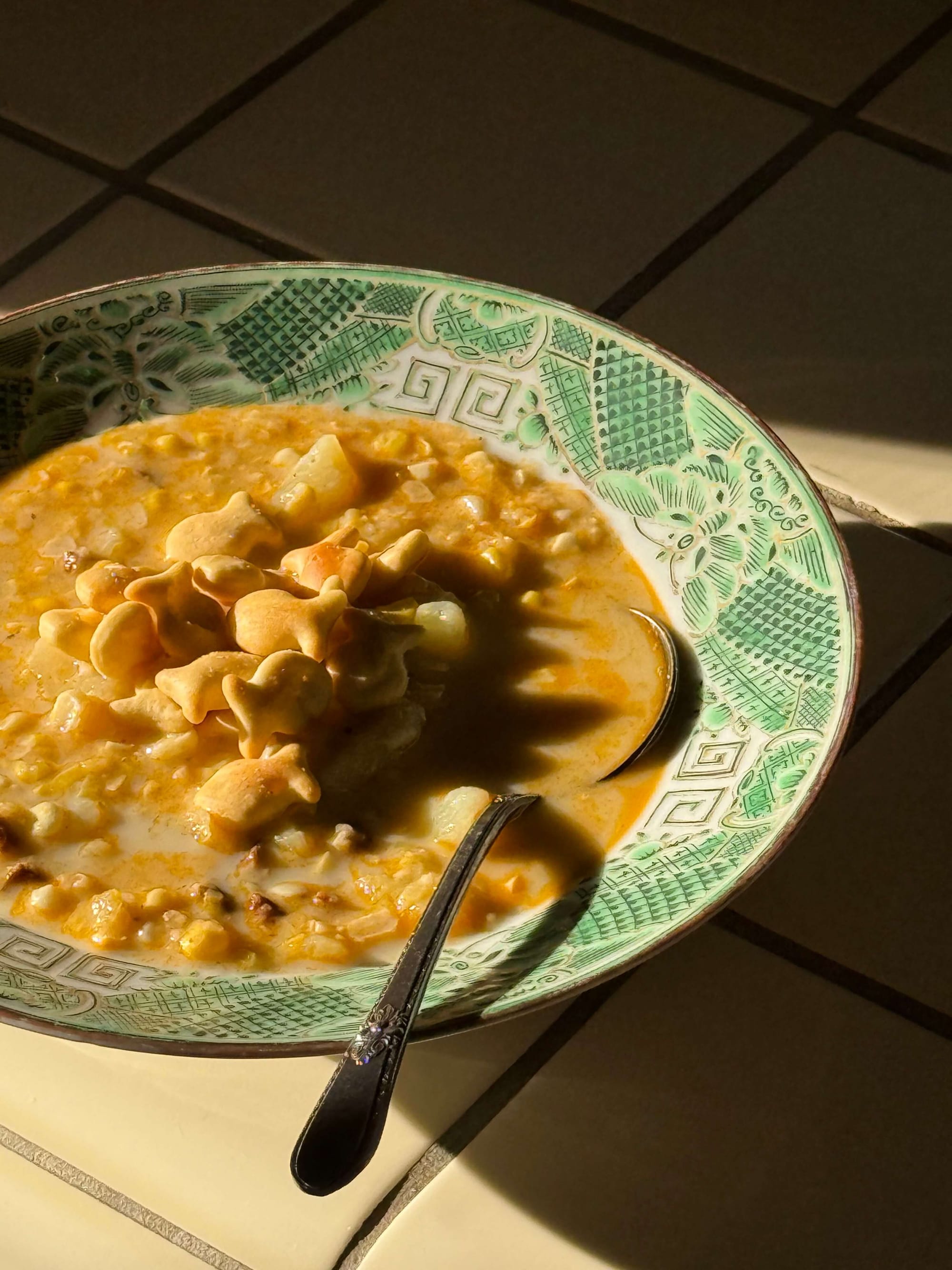
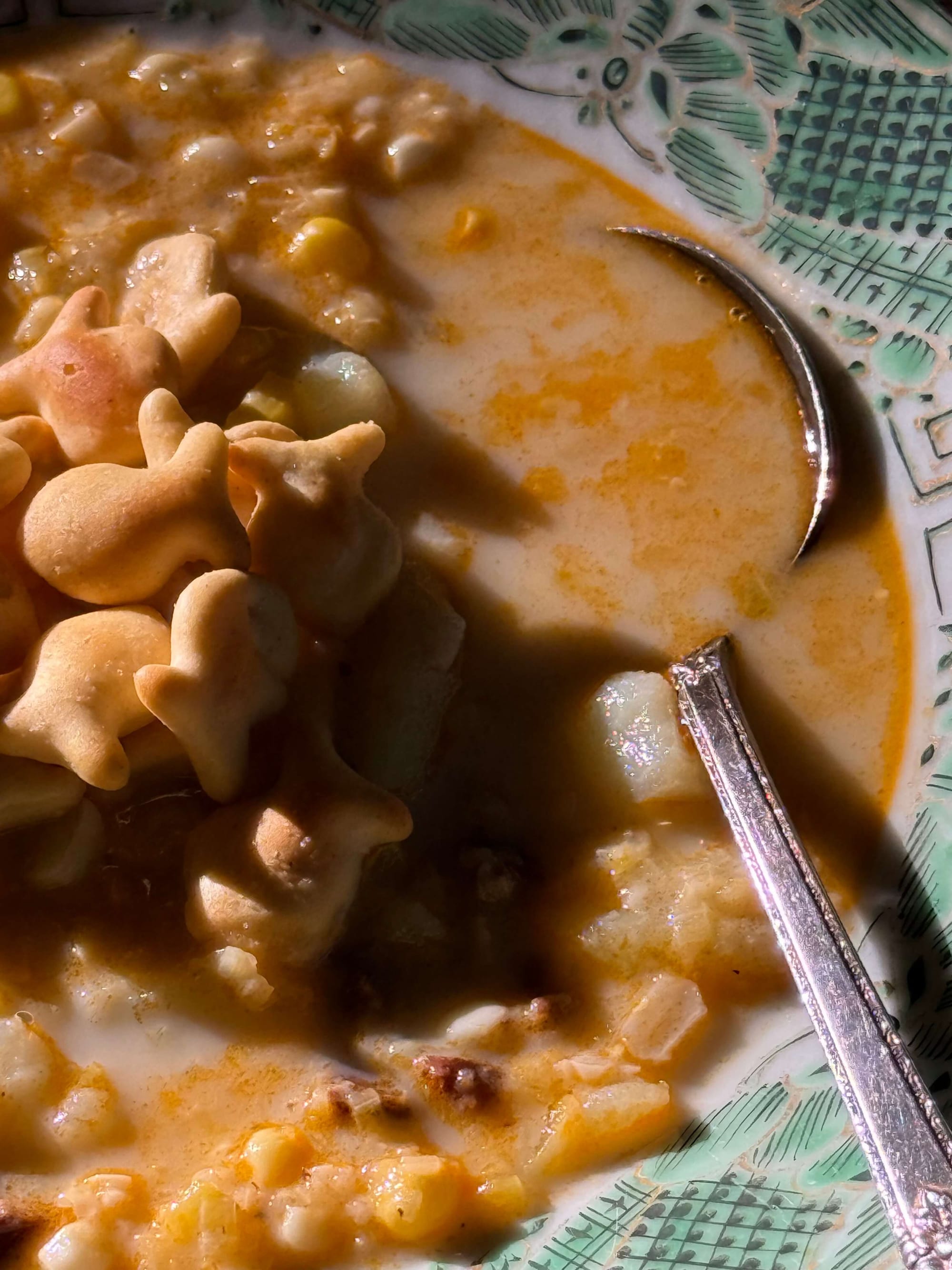
Corn Chowder, Summer’s Sweet Surrender
Welcome to Buffet Magazine, an independently owned digital food magazine. Our Thursday editions are where we feature a great new recipe. Tuesday is for features.
IN THIS ISSUE: Unsalted almonds of self-control, a historical fish butchering machine, sandwich cookies reach for the sky.
Appetizers
Almond Despair
For the last, oh, four months or so, I’ve been schlepping around a sixteen-ounce plastic jar of CVS Pharmacy® Well Market™ brand raw, unsalted almonds in my work tote, which I finally finished today. Let me tell you, they were an absolute chore to get through, although I guess that was the point. I bought them very specifically as an emergency snack, something I could reach for when hunger rendered me incapable of making reasonable next steps around securing a meal but—crucially—were not tasty enough to accidentally become a meal. If they were roasted and salted, I know they wouldn’t have lasted a week in my bag; raw, unseasoned, and maybe on the edge of rancid, I could barely choke down an Obaman septet before putting them away and rustling up some real grub. (Murder on my TMJ, too.) I desperately need to replace them, but before I do, I’m wondering if any CraBs (ComRAdes of Buffet) have employed a similar Intentionally Bad Snack strategy and, if so, what sorts of sub-delicious foods you squirrel away to keep the munchies at bay? Would be keen to find something I enjoy eating slightly more (or maybe even less). —Amiel
Nothing New Under the Sea
In response to this week’s feature about a startup developing technology to kill fish at scale, CraB Jeffey C. wrote in: “I cannot stop thinking of The Iron Chink.” Yikes! (At the name, not our beloved CraB.) I hadn’t heard of it before, but now I can’t, either. The salmon processing machine, formally known as the Smith Butchering Machine, was more commonly known by that racist nickname throughout the early twentieth century. The majority of workers in the Pacific Northwest salmon canning industry throughout the early 1900s were Asian immigrants—where they were from depended on the state of immigration law in a given decade—and the introduction of Smith’s machine led to many laborers being put out of work. (The ones who stayed and ran the machines didn’t have it great either: “One of the worst jobs,” said one former machine operator.) Automated Iron Butchers are still used in the salmon industry today. How will we think of Shinkei’s Poseidon a century from now? —Nozlee
Move Fast and Break Treats
In the bizarre world of consumer packaged goods, $5 billion is never enough. At a Barclays conference held last week, Mondelez executives hinted at major Oreo changes. The snack behemoth behind beloved staples like Ritz and Cadbury has plans to rebrand the 114-year-old cookie—think, new logo, new products, new recipes. “We’re going to have quality improvements,” said COO Luca Zaramella. “There is going to be, in some cases, new formulas that will result in better labels.” Of course, Oreo has undergone changes before. In the ’90s, lard was eliminated from the recipe (making them, amazingly, vegan); a decade later, hydrogenated oils were scrapped. This year alone, sugar-free Oreos were introduced to keep up with the better-for-you Joneses. Mondelez is staying mum on what exactly will change, but it sounds like the company wants to target non-cookie-eaters (“a different cohort of consumers from where the brand is usually accessed,” in corporate-speak). Sadly, my money is on high-protein Oreos. Coo-kay sera sera, I suppose—as long as they don’t mess with Double Stuf. —Cale

Corn Chowder, Summer’s Sweet Surrender
By Amiel Stanek
Striking a delicate balance with broth
I used to taste soup like I would taste anything else I was cooking: by corralling a little bit of every constituent part into one complete spoonful, a bite that was, to my mind, representative of the dish in its totality. If it was good, then it stands to reason that the soup would be good.
My samplings are shrewder now. Instead of plunging a spoon deep into the pot, I press it gently to the simmering surface, allowing only liquid to seep in. It’s the broth I’m after, a sip of which will determine whatever adjustments need to be made. A soup should not be judged by those first lusty bites, but by the quality of the dregs. When all the bits and bobs are gone, and all that’s left is a thin, glimmering puddle, does the bowl beg to be tipped?